
Clitic Pronouns in European Portuguese
The part of EP that breaks everyone — finally explained in a way that actually sticks.
You want to say "I gave it to her." Or "she told me everything." Or "who sent you that?"
In European Portuguese, all of that runs through one system — and it's the system most learners either skip entirely or learn wrong from Brazilian sources. Because in BP, you start sentences with pronouns. In EP, that's a mistake. A very audible one.
This pack breaks it down properly. Direct objects, indirect objects, fusion, and the placement rules that make EP sound like EP.
WHAT THIS PACK ACTUALLY DOES:
Not a grammar handout. It's the full clitic system — the kind of breakdown I give A2–B1 students who've hit the wall where Portuguese stops feeling manageable. Concept first, drilling second, real sentences from page one.
Inside:
- The difference between direct and indirect object pronouns — with a two-question test that works every time
- Lhe vs o/a vs me/te/nos — which pronoun, when, and why
- Fusion: when two clitics collapse into one (deu-lha, mandou-mo) — how to read it, how to produce it
- Proclisis vs enclisis: the placement rules that separate real EP from everything else
- Every trigger that moves the pronoun before the verb — with examples from natural speech
- The spelling changes that happen when o/a/os/as attach to verbs ending in r, s, or z
- Practice sets moving from recognition to production, including a fusion challenge
- A full answer key with explanations — not just answers
WHO THIS IS FOR:
You're at A2 or pushing into B1. You understand sentences well enough, but replacing nouns with pronouns still makes you pause — or worse, makes you reach for the BP version because it sounds more familiar. This is the pack that closes that gap.
What you'll get:
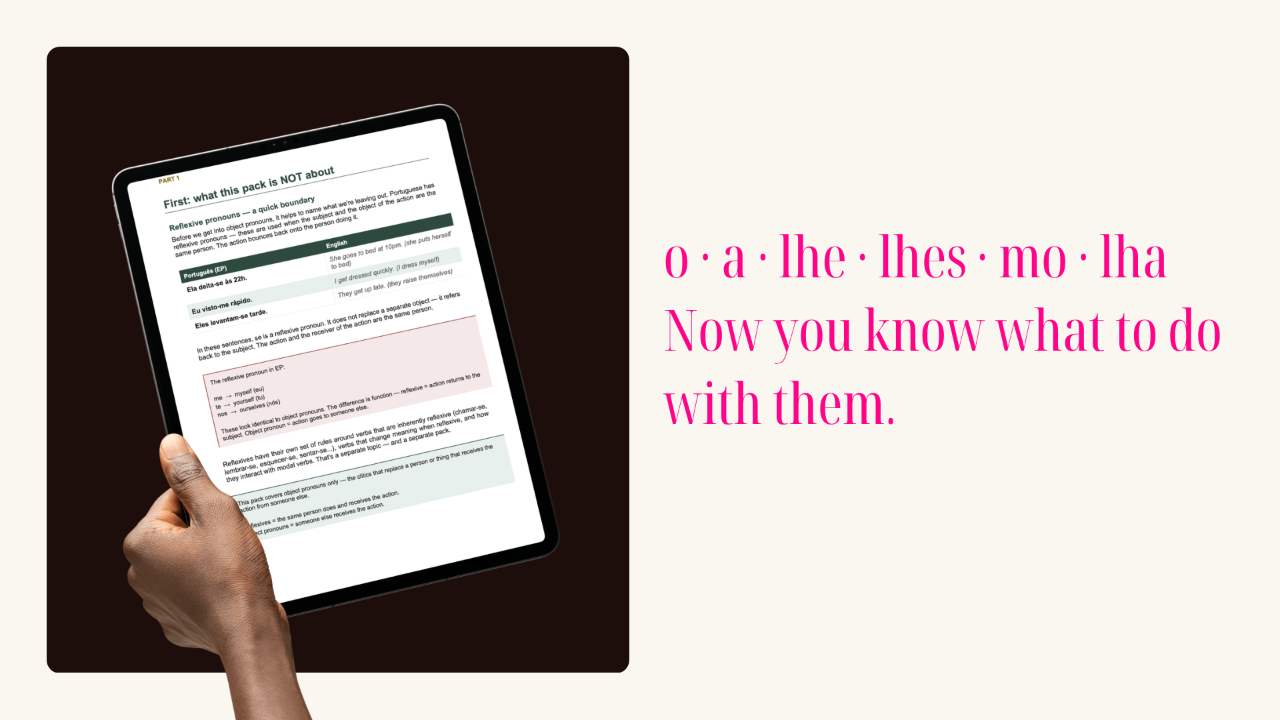
- A digital 13-page PDF you can print at home or work through on screen
One system. No shortcuts. Done right.
Com café e caos, Catarina
P.S. This is a digital download, so it's not eligible for refunds. Any questions: [email protected]